Showing posts with label Amphibians. Show all posts

Saturday, 21 July 2018

Summer Wildlife

The continuing heatwave has meant seeing much wildlife has been tricky. It's been too hot to spend much time out in the countryside, for both me and the local wildlife. It's been so hot a local farm made the national press after having the earliest harvest for forty years!1

It's therefore been a case of finding wildlife in more unusual locations. For example, I was wandering home through the centre of Ringwood one evening when I stumbled upon a group of black-headed gulls looking for food. Then I noticed that one of the gulls had a much darker head than the others.

Apologies for the low-quality phone shot!
This is a mediterranean gull. As the name suggests, this species used to be restricted to the black sea and the eastern mediterranean but has expanded it's territory to cover much of Europe. There are somewhere between 550 and 600 breeding pairs in the UK with regular individuals being found amongst groups of black-headed gulls like this one. 

I popped out to the garden on one hot evening and heard something moving in the leaf litter. I had a look and was surprised to find a common toad there. 


I initially thought it odd to see an amphibian in the garden at this time of year- I was concerned that it was too hot. Toads though are actually more tolerant of dry environments than frogs and often use gardens as their habitat in summer2. They usually stay in a hollow in the ground during the day and emerge after dark to feed on ants, slugs and worms.

One morning I headed to the bathroom and was surprised to find a stunning moth sat just above the bathroom mirror. 


This is a black arches moth. It's usually a woodland species so it's somewhat surprising to find it in a suburban environment but maybe there are enough trees nearby to support it. This species is considered a pest in forests as they feed voraciously on spruce and pine needles. A single caterpillar can eat 200 pine or 1000 spruce needles and about twice as many are damaged from being bitten off. If there are enough caterpillars or other factors in play they can causes the death of trees. 

I found this impressive moth early one evening on a fence on my street. 


This is a willow beauty but despite the name this species have a number of food plants including clematis, ivy and hawthorn- exactly the sort of plants you find in suburban gardens. They rest on the day on tree trunks though to a moth a wooden fence looks the same. 

I've been out on a few evenings in the garden trying to look for moths and whilst here have been plenty around, photographing them has proved very tricky. One species I did capture was this one. 


This is a rosy footman moth. These moths are a pink colour, which is unusual for moths, and are only found in the south of the UK- they are most common nearest the south coast. 

At the start of June I was surprised when one of the BTO's tagged cuckoos, Bowie, visited my patch. Well Bowie has now crossed the Sahara having travelled an incredible 3,040 miles since leaving the New Forest on 12th June- an average of 86 miles a day3! Cuckoos are truly incredible birds. 

Finally, I have been asking for people to share their local wildlife sightings and have received some interesting things so far. I was delighted to discover that there appears to be a strong community of hedgehogs in the centre of Ringwood with several people putting out for them. 

Picture from Hedgehogs of Ringwood FB Group
Hedgehogs have seen their populations decline 66% in the last twenty years. The centre of Ringwood is a great habitat for them as there are few cars after dark and a network of alleyways which allow them to travel between gardens. Fantastic residents providing food for them is an added bonus and with numbers like this in just one garden it's clear hedgehogs are doing well here in Ringwood.

That's all for today but with some time off for the summer coming up I expect to have lots more to share with you over the coming weeks.


Sunday, 15 April 2018

Signs of Spring

It is finally starting to feel more like Spring although we've still had lots of grey, drizzly days this week.

With the sun out one day I was keeping a close eye on a verge looking for insects when I managed to spot this well-concealed slow worm.


Slow worms, like other reptiles, hibernate over the winter(1) so this was probably one of the first times it had emerged this year. The thing I found most surprising was the location. It is no doubt on the verge because it faces the sun but seeing it next to a footpath not far at all from the centre of town was totally unexpected. 

More plants are coming into flower now that the temperatures have risen. One that I've seen a lot lately is pussy willow


Willow trees are single-sexed and these flowers only appear on the male trees(2). Both sexes produce nectar but these male flowers are important to insects due to the copious amounts of pollen they produce- the yellow blobs are the pollen. 

In several local woodlands I've seen carpets of wood anemones appear. 


Given the way they cover woodland floors you would be forgiven for thinking that they spread very quickly. However, wood anemones only spread at a rate of six feet every hundred years so are a good indicator of ancient woodland(3). Hoverflies like wood anemones are an important pollinator for the species but it's not much used to most animals as food because of an acrid taste. 

Today I was pleased to see the first bluebell of the year near the fishing lake, one solitary plant in flower. 


I went out into the New Forest this week which always leads to some lovely views. 


Whilst in the forest I heard several cuckoos calling which meant they have arrived back for the breeding season from their wintering grounds in Africa. Over the last few months I've been following the BTO's tagged cuckoos, particularly Selborne who was tagged in and returns to the New Forest(4). It's staggering to see how he has flown across much of Africa, including the Sahara desert, before crossing the sea to eventually arrive back at the New Forest. 

Meanwhile, I've spotted lots of Spring behaviour in the birds in our garden. Starlings and other birds have been ripping at the woody plant growing on the garage which backs onto our garden and flying off with whatever they can get hold of. 


The starlings nest in the cavities of the houses on our estate as they are easily accessible. You can see them disappear into the holes. Often we have some nesting in our roof and you can hear the chicks calling when the feeds begin early in the morning. 

Meanwhile it's been open warfare for the blackbirds recently. 


We seem to have two male blackbirds visiting the garden at the moment but it's not really big enough for the both of them. When they spot each other they lunge towards each other until one back off. They never seem to go far though and retreat to the safety of the shed or a fence before trying to sneak back into the feeding area. Inevitably they are spotted by their rival and the fight continues once more. 

To finish today here is a lovely piece from Ringwood TV about the Poulner Toad Patrol who help amphibians crossing the road to get to their breeding area. 


Friday, 2 March 2018

Chilly Creatures

It's been a cold few weeks here in Ringwood with temperatures rarely pushing positive figures. For our wildlife it's a huge challenge- low temperatures are always difficult and coming at the end of the winter means food is scarce. 

Last week I spotted lots of clumps of frog spawn in the New Forest, though all of it was frozen.


Frog spawn can survive freezing temperatures to some extent but it will struggle over a long period of low temperatures like we had. I suspect very few tadpoles will develop from the many clumps I spotted. 

At my workplace in Bournemouth this week I saw the car park fox for the first time in a while. 


I saw this vixen on several mornings this week in this spot. I can only imagine how difficult it must be keeping warm when you have to spend your entire time outside. This vixen was curled up in a pile of leaves in the sunshine which was probably about the warmest place she could be at 8:30AM. 

On Thursday the snow arrived. It was only a few centimetres but enough for the school I work at to be closed and some lovely views locally. 


The Avon deer didn't seem too bothered about the snow and were grazing in their usual field. 


There were lots of birds on the Avon itself- the water flows fairly fast there and that means it's relatively warm. I wouldn't like to paddle in it but it must have been better than sitting in the snow. The river was also the only source of food that was still available so it made sense for the birds to congregate there. 

Swan
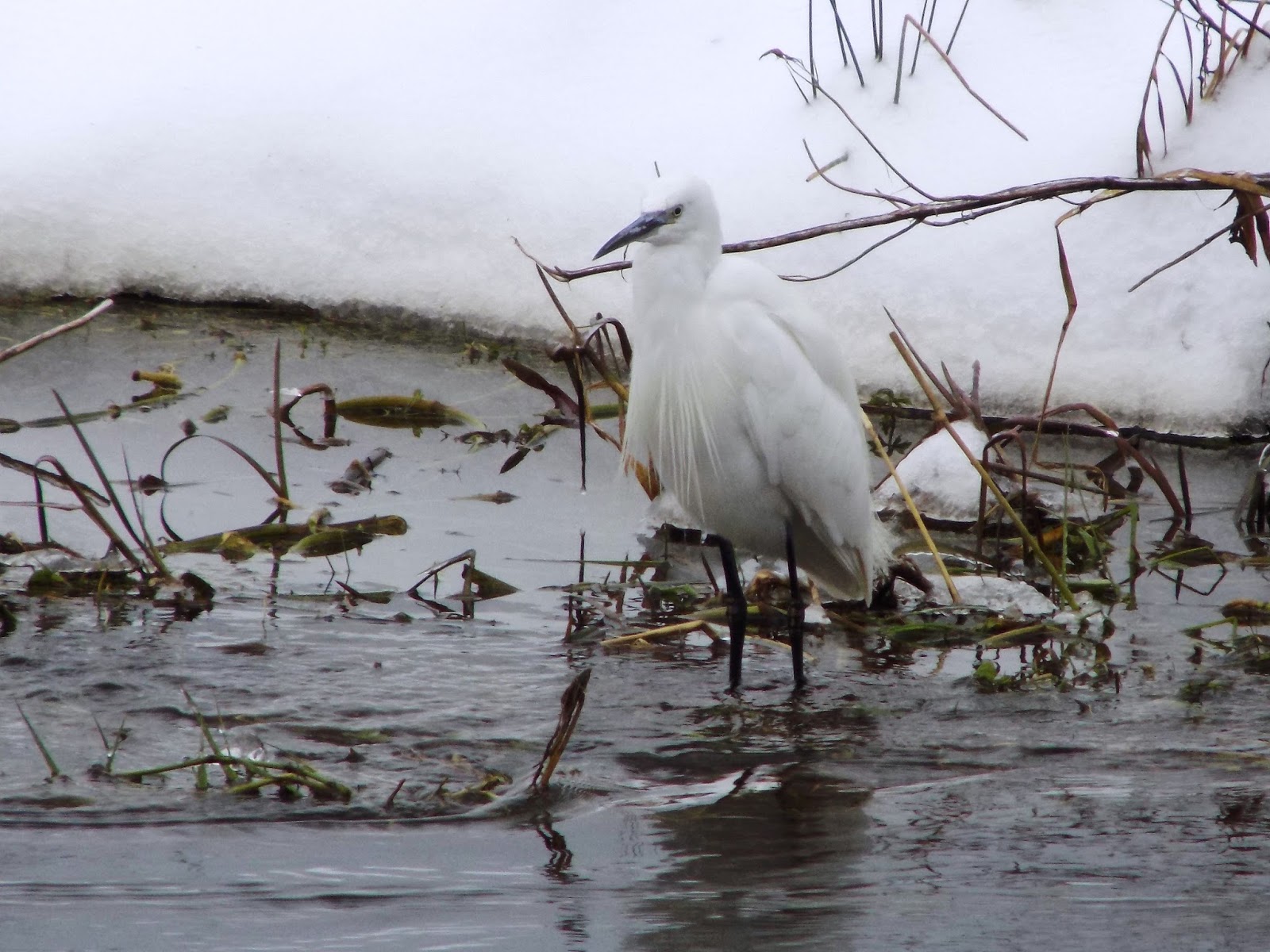
Little Egret 

Goosander stretching its wings
                             

This teal was an exciting sighting as I've never seen one on my patch before. I assume it found its way to this stretch as a fairly warm and safe haven from the poor weather. 

The small birds mostly seemed to hunker down in trees. By doing this they were keep away from the worst of the wind and can take advantage of the natural heat of the trees. 

Chaffinch
 Some, like the starlings below, stuck together in groups where their combined heat helps them all to keep warm, a bit like penguins do.


On Thursday the snow became even thicker to the point we'd had more than I'd ever seen in my twenty odd years of living in Ringwood. Freezing rain then left a hard frozen surface to the snow overnight.


There were no sign of the deer today and I suspect they took shelter in one of the nearby wooded areas. The little egret meanwhile stubbornly carried on fishing as normal. 


I was also surprised to see a number of lapwings around this patch of the river, another species I've never seen on my patch before. They were all curled up trying to shelter from the elements. 


We should have seen the last of the snow, for now at least, but it will still be difficult for all these animals to survive the next few weeks. They must do everything they can to stay warm enough to survive as well as try to find food in difficult circumstances. It's likely that many won't be able to do this and populations of many species will be the lowest they've been for a number of years. 

I'll be back soon and do safe and warm in this cold weather!


Sunday, 28 January 2018

The Friendly Frog

The last few weeks have been very wet here so I've found it quite a challenge to see much wildlife. Despite the poor weather it's clear that Spring is on the way with flowers starting to shoot out of the ground and snowdrops in bloom, as well as a few crocuses and even daffodils locally. The catkins on the hazel trees are starting to open up too.


For some time now I've been trying to get a photo of a goldcrest to share here but it's proven a challenging task. As well as being tiny, they dart around all over the place so finding one still enough to take a photo which doesn't end up blurry is very tricky. I was therefore very frustrated when one sat right in front of me last weekend when I was out in torrential rain without my camera. The best I could manage was this low-quality phone shot. 


Goldcrests are, along with the firecrest, the UK's smallest bird. They are usually around 9 centimetres long and weigh about 5.5 grams which is about the same as a twenty pence piece(1). Though many goldcrests stay in the UK all year round, many migrate from Scandinavia and mainland Europe to spend the winter here. Early ornithologists couldn't believe that such a tiny bird could migrate so far and thought they rode on the backs of short-eared owls or woodcocks, a great image but not true of course(2).

Goldcrest are almost entirely insectivores and spiders are an important part of their diet- that's likely what this individual was looking for when I saw it, looking for spaces in the old railway bridge where spiders might be lurking. 

For the first time I have an amphibian to share with you. I was just around the corner from my house when I spotted this common frog sitting in the middle of the pavement. 


Being right in the middle of the footpath in fading light was obviously a dangerous place for this frog to be so I gave it a gentle poke and it hopped safely into the undergrowth. 

Frogs hibernate in the winter so it's very early in the year to be seeing one. It is recorded that they start emerging from January though, as long as the night temperatures are higher than 5 degrees C(3). Given how early this one emerged it's likely it's a male- they tend to come out first and head towards a waterbody where they will wait for the females to arrive. Though not accessible for humans, this frog was actually only about fifteen metres away from the fishing lake so that is likely where it would be heading. 

When I write this blog I try my best to not write about the same species all the time so I usually have photos of things I don't end up sharing. As I'm really short on content and the month is drawing to a close I thought I'd share some of my previously unseen photos from January along with a few comments about some of them. 

First, here's a few of the usual suspects from a recent visit to Lymington-Keyhaven:

A group of dunlin
Dunlin are winter visitors to the UK and are usually seen in flocks like this. They feed in a 'sewing machine' action and here on the coast they eat molluscs, worms and crustaceans. 

Wigeon

Shelduck

Teal
My most regular walk is along a stretch of the River Avon where I always find plenty to take photos of. 

Mute Swan

Carrion Crow

I tend to regularly see crows all over the local area- though many birds are opportunist to some extent, crows are the more than any. Mostly I see them sitting in trees like this one where they can eat fruit or in fields where they find grain. I occasionally see them mobbing the local buzzards- they may be trying to steal prey from them- and a few weeks ago one was feeding on a dead fish which was lying on a bit of exposed gravel in the middle of the river. They will happily steal eggs and even hunt.

Grey Heron

These birds are surprisingly not instantly recognisable but they are female pheasants. Other than the shape and length of the tale they don't look very much like the males at all. I can only assume that the reason we see them far less than males is that they are much less noticeable and blend in well. Male pheasants happily breed with more than one female and then play no part in incubating or raising the chicks(4) so though they may be overlooked it's the females who are far more important to the species.


Song Thrush


That's all for today and fingers crossed the weather will improve other the next few weeks!