Showing posts with label Blashford Lakes. Show all posts

Monday, 12 February 2018

Brilliant Bramblings

The weather has continued to be poor lately, especially on Saturdays which are my main wildlife days. It's certainly been a wet winter!

I've seen the Avon roe deer a few times over the last few weeks, including the doe and fawns I first saw in July.

Roe Deer July 2017
Roe Deer February 2018
It's interesting to be able to see how they've developed in this time. Obviously they have grown a fair bit but you can see that they are still quite a bit smaller than their mother. It's also interesting to note how their coats have changed too. The fauns have lost their spots and all three have changed from their sandy summer colours to their darker winter colour. 

I've also saw one of the bucks at the weekend, potentially these fauns father and certainly a relation. 


Today I visited Blashford Lakes where I spent most of my visit in the Woodland Hide. It was really busy, both with visitors in the hide and birds on the feeders. There were plenty of the usual suspects such as chaffinches, goldfinches and blue tits. 


It was also a good day for siskins as there were a fair few visiting the feeders. 


At this time of year siskins start to appear more regularly in gardens and on feeders(1). They tend to resort to feeders when the natural seed stock has reduced and visit feeders more when the natural Sitka Spruce seed crop is low(2).

Every now and then most of the birds would suddenly fly back into the safety of the bushes, likely because there was a potential predator somewhere nearby. I did see one of these potential predators, a great spotted woodpecker. 
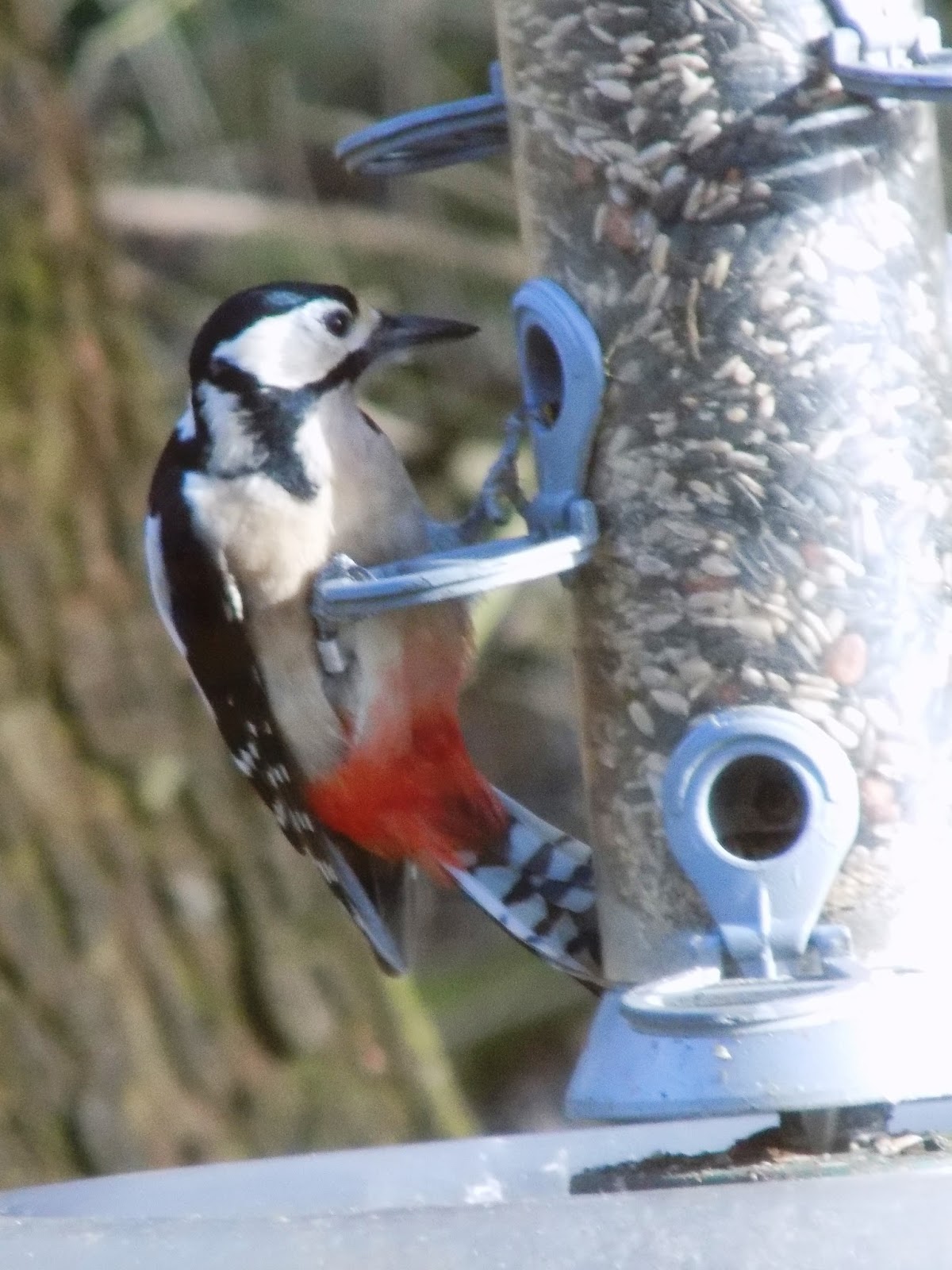

Like most woodpeckers this species mostly feeds on insects but over the winter has to supplement this with tree seeds(3). They would be unlikely to predate any of the birds present but in the spring they do feed on eggs and fledglings so they are wise to be wary of woodpeckers.It might be that they simply sense that this is a bigger bird and therefore a potential threat.

The highlight though were a few stunning bramblings. 


Bramblings are not resident in the UK and instead migrate from the forests of Northern Europe(4). As you can tell from their beaks, they are finches and like other finches mostly feed on seeds. Numbers vary depending on how much food is available but it appears to be a good year for them, as it is for bullfinches and hawfinches. 

I also got this very clear photo of a robin whilst walking round the reserve. 


Robins seem to be particularly abundant this winter. UK robins are generally non-migrantry but robins do spend the winter in the UK from Northern Europe so it's possible there is a larger influx this winter(5). At this time of year though robins are starting to secure their territories ahead of the breeding season so this could also explain why they are more visible at the moment. 

Whilst I didn't spend much time near the lakes themselves today I did spot a few interesting birds:

Green Sandpiper
Gadwall

Distant Kingfisher
I was also pleased to spot some fungi amongst the undergrowth, the stunning scarlet elf cap. 


Scarlet elf cap is a "saprotrophic" species. In simple terms, this means it digests decaying matter, usually wood in this case, and breaks the composite parts down- proteins into amino acids, lipids into fatty acids and glycerol and starch into simple disaccharides(6). These nutrients are passed through the mycelium, the fungi equivalent of roots, and help the fungus to grow. 

That's all for today but I'll be back on Saturday for my look at February's nature news.

2: Mckenzie, A.J., Petty, S.J., Toms, M.P. & Furness, R.W. (2007) 'Importance of Sitka Spruce Picea sitchensis seed and garden bird-feeders for Siskins Carduelis spinus and Coal Tits Periparus ater' Bird Study 53: pp. 236-247

4: BirdLife International (2012) IUCN Red List of Threatened Species, Version 2013.2. International Union for Conservation of Nature

6: Clegg, C.J and Mackean, D.G (2006) Advanced Biology: Principles and Applications (2nd ed). Hodder Publishing fig 14.16, pp.296

Saturday, 6 January 2018

A Great Gull

Last week I took the scope I was given for Christmas to my local nature reserve Blashford Lakes. The reserve is always a great place to visit but having the scope meant I was able to see much further than before across the sizeable lakes.


Thanks to the scope (and a nice man in the hide who pointed it out) I was able to see a bird I hadn't seen before, a ring-billed gull. 

Photo from Blashford Lakes Blog(1)
Ring-billed gulls come from North America and locals will be used to seeing these gulls in car parks where they apparently congregate in large numbers(2). They do this because they can easily see any approaching predators and there's plenty of food around in the form of rubbish humans have left behind(3).

Ring-billed gulls are rare but regular visitors to the UK. There are only a handful that winter across the UK but those that come are seen year after year- this is at least the third winter that this individual has spent at Blashford. 

The scope also allowed me to clearly identify what I was seeing- for example I was able to see that rather than the tufted duck it looked like initially, the bird in the foreground here is a scaup. 


Like many of our winter visitors, scaup breed in Siberia and Northern Europe before moving south to avoid the freezing weather. They are diving ducks meaning they dive underwater to catch food, which most consists of shellfish, crustacea and small insects(4).

Another duck I saw, and in good numbers too, were gadwalls. 


These birds are dabbling ducks which means they stick their heads under the water to find plants like algae and grasses to feed on(5). They therefore need shallower water to feed in and this is why they came relatively close to the hide. It's odd that compared with the bright colours of the male of most other species of duck that these birds are so understated. 

My other spot of note was a green sandpiper on the shore of one of the lakes. 


These waders work around muddy edges of lakes and ponds where they find small invertebrates. They breed in subarctic Europe but where they breed is unexpected- unlike nearly every other wader these birds nest in old nests belonging to species like fieldfares up trees! 

This time last year I was regularly seeing a green sandpiper on the River Avon- the river level remained fairly low throughout the winter. This year though we've had a very wet winter and the river levels are significantly higher. 

River Avon December 2017
Green Sandpiper on the River Avon, December 2016
As you can see, the sandpiper was feeding on parts of the river bed that were exposed whereas this winter even most of the plants have been submerged. According to the Met Office, locally we had about 50% of the average expected rainfall for December in 2017(6) whereas in December 2016 it was just over 20%(7). 

The scientist in me finds this information fascinating. Last winter was clearly unusually dry which meant the green sandpiper had a place to feed it would never normally have. Even 2017 seems fairly dry though the data only goes to the 27th of December and the remaining four days were extremely wet here- I estimate the figure to be closer to 70%.

According to the Met Office, 2017 was the fifth warmest year in the UK since records began in 1910(6). Scarily, the nine warmest years since 1910 have occured since 2000. Whilst the weather may change it's so clear that climate change is happening and the data shows it is happening alarmingly quickly. 

That's all from me today but I just want to direct you to my new Facebook page- if you're on Facebook give it a like for all the latest blog updates as well as local news stories and extra photos.

Sunday, 24 December 2017

Super Shovelers

It's been a fairly mild week which means our winter visitors are likely happy with their choice to spend the season in the UK. This week I paid a visit to Blashford Lakes which is probably at its busiest time of the year in terms of bird life.

I was lucky to get very close to one of the trees cormorants like to perch in and this resulted in a photo I'm really pleased with.


The UK has an internationally important wintering population of these birds, some 41,000 birds1.Unlike other birds they are not too particular about their habitat and will happily go to freshwater lakes like at Blashford, estuaries or the coast- anywhere with a good supply of fish is OK with them. 

I also saw a few of what is becoming my favorite waterfowl, shovelers. 


These birds are so odd-looking. Females look much like female mallard only with an enormous bill whereas males have a beautiful green head. They use their remarkable bill to forage for aquatic invertebrates2. The bill has 'lamellae' on the edge which are comb-like structures that act as sieves- this allows the birds to skim invertebrates from the water's surface. This adaptation means they don't have to compete with food resources with other ducks. 

Again the UK is an important place for these birds as 20% of North West Europe's population call it home3. 

Another spot was this lovely little grebe. 


Little Grebes are superb swimmers and pursue fish and invertebrates underwater up to a depth of one metre4. They are buoyant due to not having a tail and reappear from dives like a cork. Like other grebes though they are not good at walking and nest right at the water's edge for this reason. 

It's not all waterfowl at Blashford of course- I also spotted this green woodpecker. 


This bird was almost certainly feeding on ants here, which take up the vast majority of their diet5. It probes it's long beak into the ground and licks up ants and their larvae. Their tongues are long, about 10cm- so long in fact that they have to wrap around the skull in order to fit in the head6!

Moving elsewhere, I spotted a pair of goosander when I was walking past the River Avon this week. 


These birds use their long serrated bills to catch fish- they especially like trout and salmon7. They also have been known to eat virtually any other aquatic creatures they can find from molluscs, crustaceans, insect larvae and amphibians to small mammals and birds on occasion8. 

When walking in the New Forest this week, I came across a sizeable herd of fallow deer which included one white individual. 


Normally fallow deer are light brown and spotty but they coat does darken in the winter. Even so, you would normally expect to see pale spots on these deer but this does vary between populations. It's only the distinctive tails that tell me these are definitely fallow deer. 

You might imagine the white deer to be an albino but actually white is fairly common in deer as it's simply natural variation9. I suppose it's similar to humans having ginger hair in that it's a less common variation but a still a relatively high proportion of individuals have it.

That's all for today but I hope you have a good Christmas and I'll be back next week with my end of year round-up.

4: BirdsUc: Little Grebe
5: RSPB: Green Woodpecker
6: Robinson, R.A. "Green Woodpecker" BirdFacts. BTO
7: RSPB: Goosander
8: del Hoyo, J. Elliott, A, Sargatal, J (eds) (1992) Handbook of the Birds of the World Vol 1. Barcelona: Lynx Edicions. pp. 626
9: BDS: Fallow Deer

Thursday, 10 August 2017

Walter's Return

I was pleased to spot this bird today when I was visiting Blashford Lakes.


This is a great white egret, specifically Walter White. This individual has been coming to Blashford every winter for fourteen years now. He was ringed as a chick in France and so we know he is fourteen years and three months old. This means he is by far the oldest known great white egret in the UK. When he first arrived he was one of only about three of the species to visit the UK. Now they are considerably more common and even breed here. 

Walter's arrival is a sign that the new winter migrants are starting to arrive. On the River Avon I spotted this goosander happily feeding away. 


Goosanders do breed in the UK but not here on the South coast- we only see migrants over the winter. I think this individual is probably a juvenile as it hasn't developed the sticky-up feathers on the back of the head. 

Another juvenile bird I have seen recently is this tiny robin. 


This was a very young bird- it still has very downy feathers and didn't try to flee when I came close. It did know to go into the undergrowth though but it wasn't very mobile. I suspect it had only left the nest that morning or the night before. 

Here's a buzzard I saw recently:


Buzzards like to roost on dead trees and telephone poles as opposed to trees surrounded by leaves which obscure their view to the ground. Most buzzard prey is on the ground so they need a clear view to see movement in the grass. I think that the rangers at Avon Heath, where I saw this buzzard, have intentionally carved these trees so they make good buzzard perches. 

When walking along a quiet footpath last week I came across a wasp nest that had been dug out of the ground. 


The fact the nest was fairly intact and there were still a large number of wasps around suggests this was newly dug up, probably the night before I found it. I looked into what animal might be responsible for digging up this nest and it was almost certainly a badger. I was delighted to find this out as I've never had any evidence of badgers in the area before.

The reason badgers do this is to eat the wasp larvae. They dig through the top of the nest to get to the grubs and this avoids the worst of the stings from the guard wasps. It's also thought their thick fur helps to protect them from the stings too. Apparently badgers have been seen to ignore a wasps nest over several weeks and then go and dig it out on one particular night. It's thought that they do this to try to maximise the number and size of wasp grubs inside. 

I was pleased this week to get another clear view of the roe deer doe and her two fawns. 


It's only been two weeks since I last saw this family but the fawns have grown considerably in this time. They are now much closer in size to their mother and the white spots on them are gradually disappearing. They certainly appearing to be developing well which means they have a strong chance to making it through their first winter. 


That's all for today but I'll be back with a post focusing on insects at the weekend. By the way, you can now follow this blog by e-mail. If you enter your e-mail address in the box at the side of the page (→→→ ) every new blog post will go straight into your inbox! See you soon.

Wednesday, 2 August 2017

Moths and Mammals

You never know where you'll find wildlife. I was walking along a busy street when I spotted a moth on the brick wall I was passing.


This is a riband wave which is a common species in the UK though it is late in the year to be seeing it- it might well be a second brood. They are night flyers though so you don't usually see them as clearly as this. 

Another moth I spotted recently was this one, which wasn't keen on having it's photograph taken and kept trying to hide among the brambles. 


This one is a mother of pearl, the name coming from the rainbow-like lustre the wings produce under the right light. Moths are classed as either macro (big) or micro (small) and oddly this is a micro moth, despite being larger than many macro moths. The larvae feed on nettles which is likely why I saw several of these amongst the brambles. 

I visited Blashford Lakes this week and got really clear views of a family of black-headed gull chicks. 


You can see how well camouflaged they are against the gravel shore. Black-headed gulls are of course very common birds and seen inland over most of the UK but it hasn't always been so. 100 years ago they were fairly rare, especially inland, but now there this is a breeding population of over 100,000 pairs. It's likely this rise is due to how well they live alongside humans, as happy to eat human leftovers as they are to eat insects and plants. 

Another bird spot at Blashford was this one:


Whilst I can't be certain from this low quality image, this is probably a reed warbler. This tree is right on the edge of a large areas of reeds- this is a species that sticks to the habitat in it's name. Reed warblers are migrants, coming to the UK to breed in the summer and over-wintering in Sub-Saharan Africa. They are one of the main host birds for cuckoos. 

Only a few steps away from this warbler was this really striking insect.


This is a four-banded longhorn beetle (say what you see!). It's a fairly common species but the adults don't live for very long so it's not seen as often as the numbers would suggest. 

A rabbit had a good look at me as I approached in the same area too:


Another mammal sighting this week was of a roe deer buck. 


This individual has sizeable antlers for a roe deer so is clearly a well-developed adult. It was also seen in the same place as the doe and two fawns I saw last week so it's highly likely that this is the father. Roe deer are territorial but male and female territories do overlap- it's unlikely any other males have entered this area to breed with the female with this guy around.  

Finally for today, I was stood only about four metres from the bird table when a flock (or 'volery') of long-tailed tits arrived. 


I counted eight on the feeders at once and it's likely there were more in the area- long-tailed tit groups usually have about twenty birds in them. They are particularly social birds and often help each other in bringing up young if their own nests fail. A study suggested that as many as half of long-tailed tit nests had one or more helpers to feed the young. 

I shall be back for more at the weekend where amongst other things I'll be discussing the weird world of oak galls...