Showing posts with label Fungi. Show all posts

Sunday, 8 April 2018

From Rain to Sun

We had a lot of rain here over the Easter weekend. The river levels reached as high as I've ever seen them with one measure suggesting water levels reached as high as four feet (1.2 metres).


The river meanders across the footpath meaning that the path and the few trees either side of it were the only dry land for some distance. This probably explains why I managed to spot this bank vole right next to the path. 


Bank voles have a longer tail than other voles, usually some fifty percent of their length1. They live in burrows with multiple entrances and I saw this individual disappear into one of them. It's likely some of the other led into flood water so this vole was probably limited in where it could go. They are a common species and an important prey species for foxes, owls and other birds of prey. 

I think the rain probably triggered a large amount of sap to secrete out of a recently cut tree branch along one of the paths. 


The smell of the sap was really strong and it was attracted lots of invertebrates. In the photo above you can see a woodlouse feeding on it and there was a steady stream of ants coming to and fro to the sap. 


The wetter weather has also probably supported some of the fungi species I've seen this week. These golden globules on a fence post are fungi of the genus dacrymyces probably a common jellyspot.


These fungi often appear on fence posts and can be found at any time of year where there's wet weather2. 

I also spotted this witches butter fungus. 


This fungus gets its name from it's yellow colour though during wet weather it turns much darker as you can see. 

On Thursday the rain finally stopped and the first butterflies of the year emerged. 


This is a brimstone and I saw lots of these in flight on Thursday. Brimstones hibernate in the winter in ivy, holly and bramble and then re-emerge on warm spring days, though usually a few weeks earlier than this3.I also saw a handful of peacock butterflies which also hibernate over the winter4.

I was also pleased to see some more flowers emerging


This is lesser celandine, a woodland flower which is one of the first to flower- as you can see here, they provide a useful lifeline to insects when few others are in flower. 
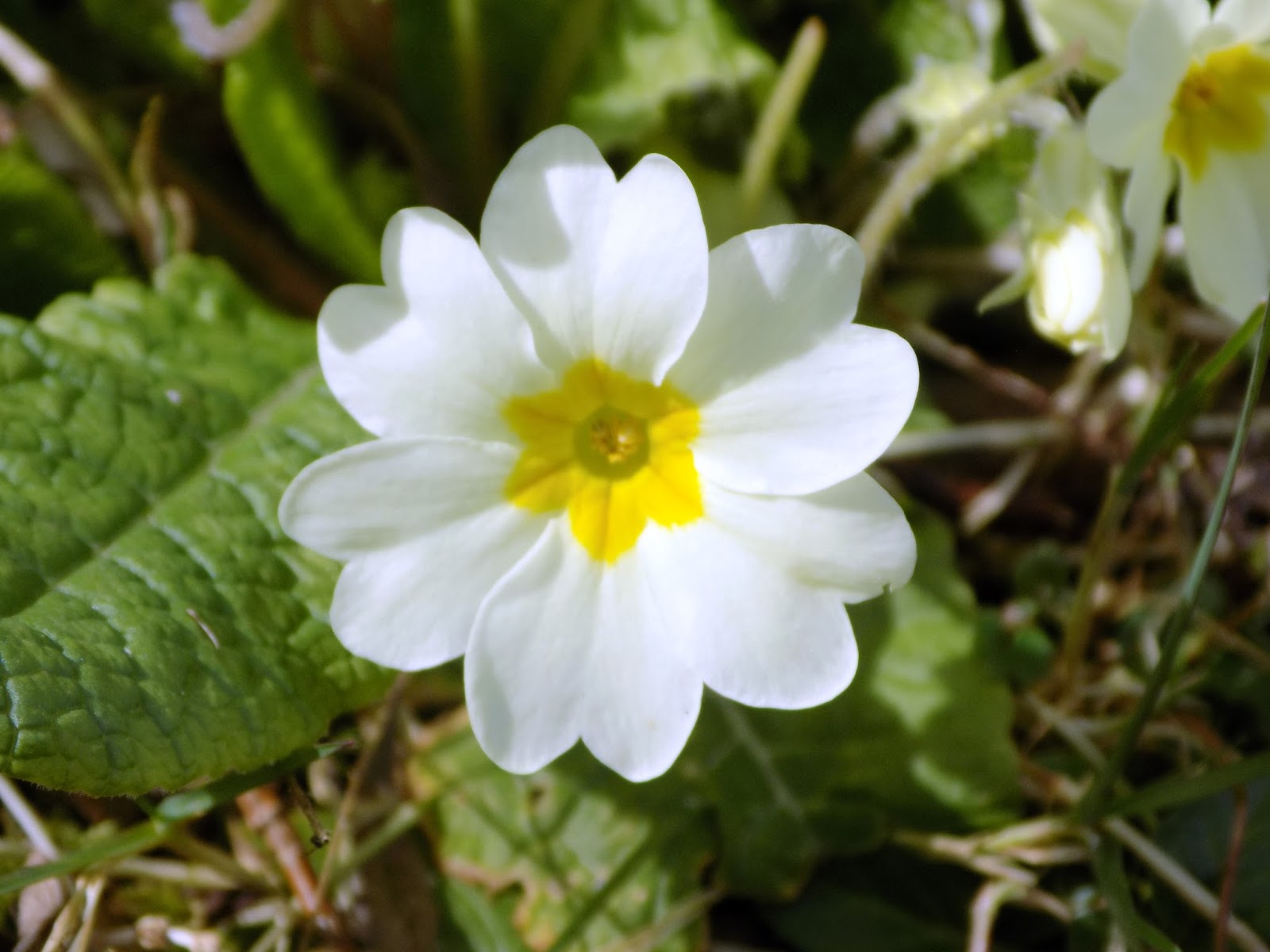

This is a primrose which although I saw in the wild looks to me like a cultivated variety. Though primroses are often yellow it's also quite common to see them in this paler form. The name 'primrose' literally means 'first rose', indicating it's early flowering. 

Finally, here's a bird I stumbled on at a quiet patch of river, a little grebe. 


This bird is already in it's summer plumage. Little grebes eat fish like other grebes but as they are smaller only eat smaller fish, meaning they are distributed more widely. Though relatively common they can be difficult to see, especially at close range, because they are shy and normally dive under the water and resurface some distance away5. This individual tried to do that but it was still close enough for me to photograph when it emerged. 

1: Konig, Claus (1973). Mammals. Collins and Co. pp. 110-111

Monday, 12 February 2018

Brilliant Bramblings

The weather has continued to be poor lately, especially on Saturdays which are my main wildlife days. It's certainly been a wet winter!

I've seen the Avon roe deer a few times over the last few weeks, including the doe and fawns I first saw in July.

Roe Deer July 2017
Roe Deer February 2018
It's interesting to be able to see how they've developed in this time. Obviously they have grown a fair bit but you can see that they are still quite a bit smaller than their mother. It's also interesting to note how their coats have changed too. The fauns have lost their spots and all three have changed from their sandy summer colours to their darker winter colour. 

I've also saw one of the bucks at the weekend, potentially these fauns father and certainly a relation. 


Today I visited Blashford Lakes where I spent most of my visit in the Woodland Hide. It was really busy, both with visitors in the hide and birds on the feeders. There were plenty of the usual suspects such as chaffinches, goldfinches and blue tits. 


It was also a good day for siskins as there were a fair few visiting the feeders. 


At this time of year siskins start to appear more regularly in gardens and on feeders(1). They tend to resort to feeders when the natural seed stock has reduced and visit feeders more when the natural Sitka Spruce seed crop is low(2).

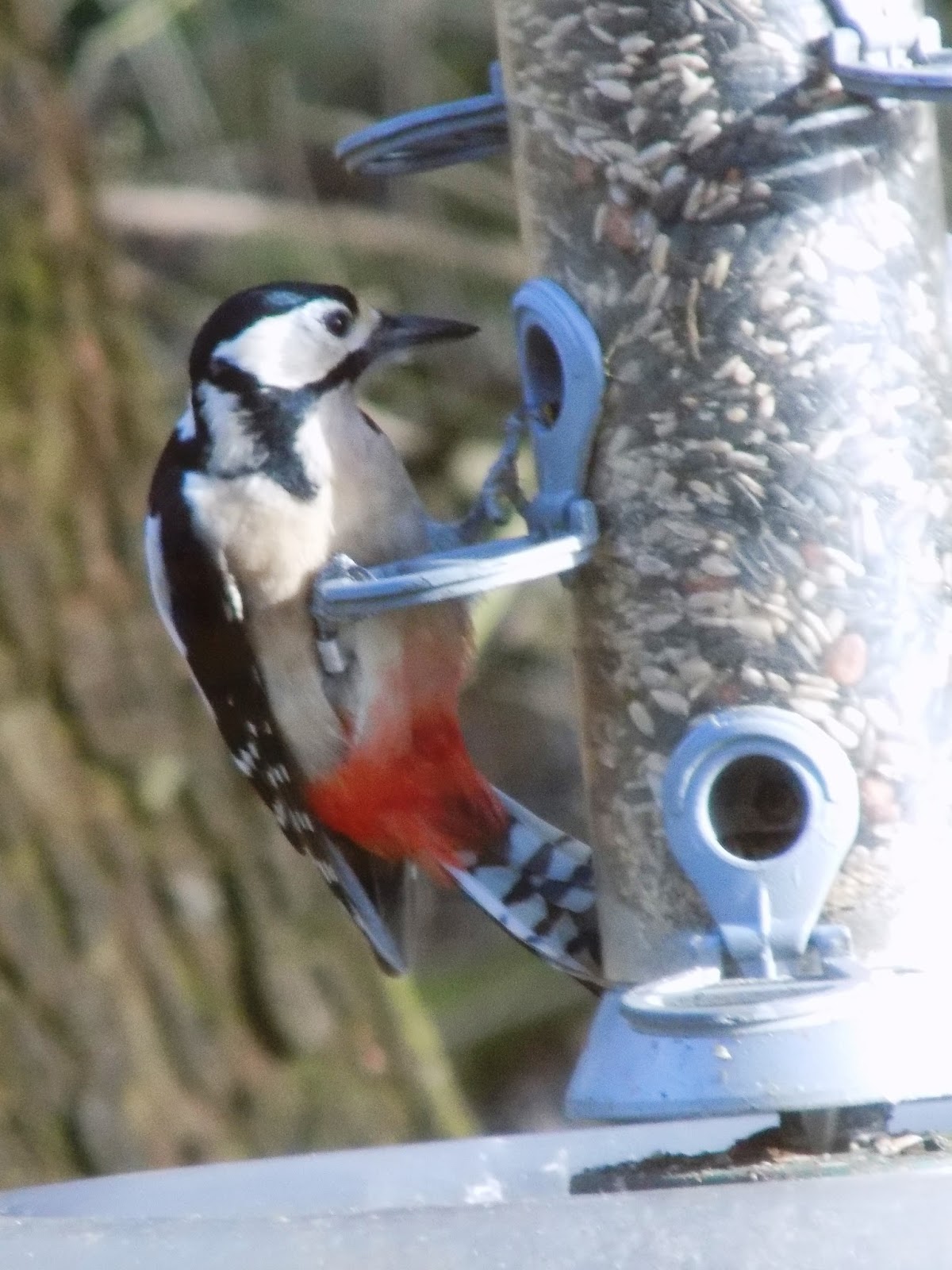
Every now and then most of the birds would suddenly fly back into the safety of the bushes, likely because there was a potential predator somewhere nearby. I did see one of these potential predators, a great spotted woodpecker. 


Like most woodpeckers this species mostly feeds on insects but over the winter has to supplement this with tree seeds(3). They would be unlikely to predate any of the birds present but in the spring they do feed on eggs and fledglings so they are wise to be wary of woodpeckers.It might be that they simply sense that this is a bigger bird and therefore a potential threat.

The highlight though were a few stunning bramblings. 


Bramblings are not resident in the UK and instead migrate from the forests of Northern Europe(4). As you can tell from their beaks, they are finches and like other finches mostly feed on seeds. Numbers vary depending on how much food is available but it appears to be a good year for them, as it is for bullfinches and hawfinches. 

I also got this very clear photo of a robin whilst walking round the reserve. 


Robins seem to be particularly abundant this winter. UK robins are generally non-migrantry but robins do spend the winter in the UK from Northern Europe so it's possible there is a larger influx this winter(5). At this time of year though robins are starting to secure their territories ahead of the breeding season so this could also explain why they are more visible at the moment. 

Whilst I didn't spend much time near the lakes themselves today I did spot a few interesting birds:

Green Sandpiper
Gadwall

Distant Kingfisher
I was also pleased to spot some fungi amongst the undergrowth, the stunning scarlet elf cap. 


Scarlet elf cap is a "saprotrophic" species. In simple terms, this means it digests decaying matter, usually wood in this case, and breaks the composite parts down- proteins into amino acids, lipids into fatty acids and glycerol and starch into simple disaccharides(6). These nutrients are passed through the mycelium, the fungi equivalent of roots, and help the fungus to grow. 

That's all for today but I'll be back on Saturday for my look at February's nature news.

2: Mckenzie, A.J., Petty, S.J., Toms, M.P. & Furness, R.W. (2007) 'Importance of Sitka Spruce Picea sitchensis seed and garden bird-feeders for Siskins Carduelis spinus and Coal Tits Periparus ater' Bird Study 53: pp. 236-247

4: BirdLife International (2012) IUCN Red List of Threatened Species, Version 2013.2. International Union for Conservation of Nature

6: Clegg, C.J and Mackean, D.G (2006) Advanced Biology: Principles and Applications (2nd ed). Hodder Publishing fig 14.16, pp.296

Sunday, 14 January 2018

Monarch of the Building Site

Hello and welcome to a rebranded blog. As you will no doubt have noticed if you are a regular reader, the blog is now called Ringwood Wildlife Diary and there's a new header too. In terms of content though it will be business as usual.

It's been interesting over the last few months to see how the roe deer are adapting to the building site on the field they used to graze in. The builders piled up the soil from the groundworks into a big mound which became covered in greenery. The deer seemed had discovered a new place to feed.


It's not just the deer that seem to like the mound- I've regularly seen the local buzzards on it. 


The mound provides a vantage point over the surrounding fields that didn't exist before and so the buzzards have taken advantage of it. Since Christmas more work has been done and fresh soil has been added to the mound- since then I've not seen any wildlife making use of it. 

Over on the River Avon I got a really close look at a pair of goosander. 


A woman saw me taking photos of them and asked me what they were and I was able to explain about them being winter visitors. It was really lovely to be able to share my knowledge with someone. 

It's proving to be a good spot for birds at the moment. I once again saw a grey heron with a rat in its beak in the same spot too. 


It still feels odd to see a bird we know for fishing to eat rats but they are opportunistic hunters. Because they can stand so still the rats don't notice they are there until it is too late. It was interesting to see that this heron had flown to the edge of the river with the rat. A second after this photo it dipped the rat in the water, lifted it up to swallow it and then bent down to take another gulp of water. I'm assuming it did this in order to make the rat easier to swallow. Compared to a slimy fish, a furry rat will not slide down the throat so easily- presumably making it wet makes it easier. 

All members of the heron family will do this and it was interesting to spot two great white egrets in the distance. 


I've never seen these birds on the area I consider my patch so it was a lovely spot. There is a fair amount of water on the floodplains at the moment and the egrets were making use of it- I wonder if they too were hunting for rats in an area where there is clearly a good number of them. 

Another winter visitor I've seen recently was this redwing, my first of the winter (clearly I've not been going to the right places). 


This redwing will have migrated from Russia or Scandinavia, arriving in the UK around October(1). It's a five hundred mile flight across the North Sea and in rough weather many come crashing down on the waves and drown. In the Autumn they spend their time in hedges and orchards feeding on fruit but as that food source runs out they move to fields to dig for earthworms. Clearly that's what this individual was doing as it has a very muddy beak. 

It may not be the height of the fungi season but I've spotted a couple of interesting species recently. This is a yellow stagshorn fungus(2). 


This species always grows on rotting wood- here it was on some wood used for steps on a footpath. Apparently it's not poisonous but is not worth eating as it's rubbery and tasteless(3).

Then there's this species which I think is an oyster mushroom. 


Oyster mushrooms are highly variable(4) which makes a positive identification tricky- I'm sure this is at least of the Pleurotus genus. Incredibly this is a carnivorous mushroom- it traps and ingests nematode worms which provide it with nitrogen and other chemicals(5). Oyster mushrooms are highly popular for eating and are regularly found for sale in supermarkets. 

That's all for today and I shall see you next week.

2: Sterry, P and Hughes, B. (2009) Collins Complete Guide to British Mushrooms and Toadstools. Collins pp.248
4: Sterry, P and Hughes, B. (2009) Collins Complete Guide to British Mushrooms and Toadstools. Collins pp.222

Monday, 21 August 2017

An August Assortment

I always try and theme my blog posts but every now and then I just end having a random hodge-podge of things I've seen recently. Today is one of those times.

Let's start with some birds. I was delighted to spot some swallow chicks calling for food on reeds on the shore of the Avon recently.


Given the time of year it's possible that these chicks are from a second brood- swallows tend to have two broods a year. The young stay with their parents for about a week after leaving the nest which means these chicks hatched around a month ago. Sometimes birds from the first brood will assist in feeding birds from the second brood- these young chicks may have been fed by their older siblings as well as their parents. 

I spotted on our local buzzards recently. 


A few weeks ago I talked about how buzzards like to perch on dead trees where there are no leaves to obscure their view. This guy was having none of it and sat happily amongst the leaves! 

Before sitting on the tree this individual spent a long time circling the skies on the thermals. I've tried to capture buzzards in the air many times but it really works- this time I at least got a passable photo. 


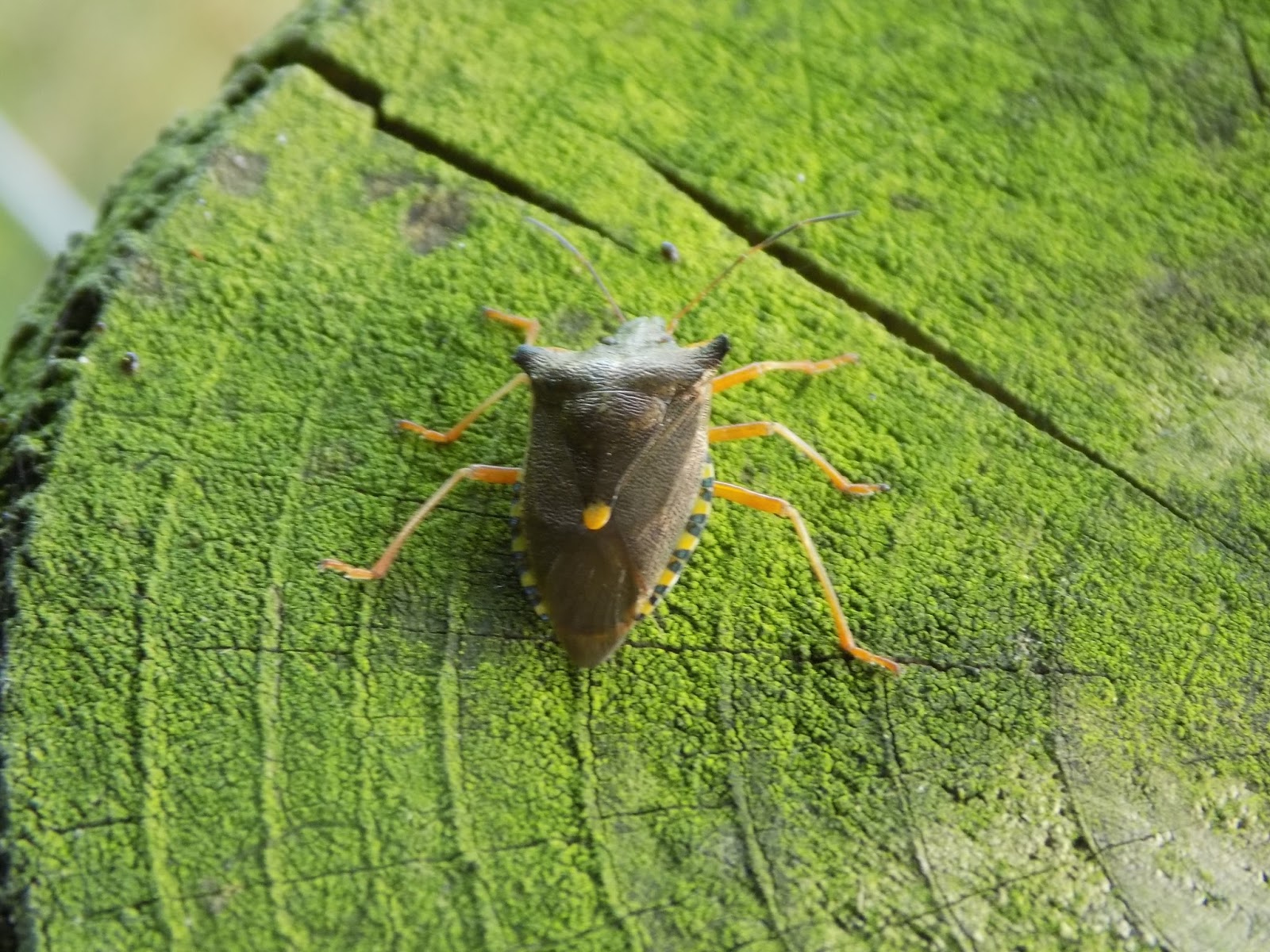
On the path near the buzzard I saw loads of these forest bugs sat on top of the fence posts. 


I've seen several similar shield bugs over the summer but this species is the largest and has a dash of colour to it as well. This bug mainly feeds on the sap of oak trees but will also feed on other trees and will even eat caterpillars and insects. 

Which is bad news for this fellow who I found crawling down another of the fence posts. It turned out this one was easier to video than photograph. 


I'm not sure on the species of this- it's likely to be a geometrid, i.e. a member of the geometer moth family but it's too difficult to tell beyond that. I love the way taps the tiny fly as it crawls along here. 

It wasn't the only caterpillar I spotted recently as I saw this magnificent specimen sat on a bench: 


This is a buff-tip moth caterpillar. The moth itself looks really like a bit of branch but the caterpillar is much more visible. The caterpillars feed on a range of deciduous trees and can even defoliate entire branches. They overwinter as pupae in the ground. 

I've also seen a few adult moths lately. This is not a great photo but thanks to the distinguishing feature it's clearly a silver Y moth. 


You can see a silver letter 'y' on the wing of this moth, making it perhaps the easiest moth to identify from this angle. Whilst virtually all the moths I have been able to identify were seen during the day, I did spot this one attracted to the light of our conservatory one evening. 


This is the dusky pearl moth (Udea prunalis). As you'd expect this is a nocturnal species and one that is only seen over the summer months, between June and August. It likes hedgerows so is probably attracted to the overgrown hedge in next door's garden. 

A few fungi to finish I think. First here is an Amnita though I'm not sure of the exact species. 


What I am sure of is that this would make you very ill if you tried to eat it. Next we have the Blackening Waxcap (Hygrocybe conica). 


This species turns black with age, hence the name. There's debate on how edible this one is- some say you can eat but there have been at least one report of poisoning from eating this species in the past. Suffice to say I won't be trying it anytime soon. 

Finally, here's a scarlet brittlegill (or potentially a similar species). 


Again there are reports this is edible but eating something that is bright red is never a sensible idea. There's a reasons why the russulaceae are sometimes also known as 'sickeners'! 

Saturday, 5 August 2017

Spot the Gall

Today I'm discussing the weird subject of galls. Galls looks like fruit or blight on a plant and are caused by the larvae of various species of wasp. The larvae release chemicals which cause the plant to produce odd looking appendages which the wasp larvae can then live in.

Galls occur on many different plants but are mostly commonly found on oak trees. Indeed, our native oak is the host plant for over 30 different species of gall wasps. I've seen lots of oak galls over the last few weeks and thought I'd discuss a few- incidentally these three were all found on the same tree.

First is an oak apple gall which is caused by the Biorhiza pallida gall wasp. 


Now oak gall wasps tend to have complex life cycles. They usually have alternate generations that are sexual with males and females followed by asexual generations with only females. Males and females of this wasp emerge in the summer and the females lay eggs on the roots of the oak tree. The asexual generation then produce galls on the roots from which females emerge in late winter to lay eggs in buds on the twigs, eventually leading to the formation of these galls. (Told you it was complex!)

This next one is an oak artichoke gall caused by the Andricus fecundator wasp.


This wasp lays eggs in the buds at the tips of shoots- the bud itself becomes greatly enlarged at this time of year. The next generation of wasps in Spring cause small galls on male catkins. 

Finally, this is a knopper gall formed by the Andricus quercuscalicis wasp. 


This wasp only became established in the UK in the 1970s. It lays its eggs in the developing acorns, causing the acorns to deform in this strange looking way.

It's easy to imagine that galls cause problems for the oak tree but other than reducing the number of acorns they have little effect. The galls wasps need the trees as part of their life cycle so it would be no good for them if their actions caused harm to the tree. 

There are galls wasps that use all sorts of different species of plants too. One I've seen is the robin's pin cushion gall caused by the Diplolepis rosae wasp. 


These galls are found on roses, usually wild ones. The wasp lays eggs in the buds of developing leaves which hatch into small white maggots. The maggots then secrete a chemical which causes these abnormal growths. 

Although they look soft and mossy on the outside they actually have hard woody structures in the middle which contain a number of chambers where the grubs develop. The grubs pupate overwinter inside the galls. Like with oak galls, this has very little effect on the plant. 

As I've been discussing weird growths today I thought I would also share a few fungi I've found this week. 

In the woods at Avon Heath there were fungi everywhere. 


I've struggled to identify this one to the species but I'm fairly sure it's a brittlegill, genus Russula.

Then there's this oddity which might be a misshapen jelly ear fungus (but I'm not certain at all!). 


Finally, an easy identification, a parasol fungus. 


Well I hope you enjoyed that dip into some of the weirder things of British nature. It'll be back to normality on Wednesday!